Michael Branch had just been sentenced to seven years in prison after pleading guilty to drugs offences. He was being transported back to HMP Altcourse, but, this time, the prison van took a different route to his previous court appearances during four months spent on remand.
In the small part of the outside world he could view from the window, he caught sight of the unmistakable and illuminated ‘Everton Tower’ on the club’s famous crest, sandwiched between two winners’ laurel wreaths, and Everton’s Latin motto, ‘Nil Satis, Nisi Optimum.’ ‘Nothing but the best is good enough’.
This was November 2012. And the van was driving past Goodison Park. The stadium where, just over a decade-and-a-half previously, Branch had spectacularly burst onto the scene as one of the most exciting young players of his generation.
Lauded by Gary Lineker, hailed as the next Robbie Fowler, a poster boy for Wayne Rooney, the striker had made his Everton debut as a 17-year-old substitute against a Manchester United team including David Beckham, Roy Keane, Ryan Giggs, Eric Cantona and Andy Cole.
His first goal came in a 2-2 draw at Chelsea when the other scorers comprised Gianfranco Zola, Gianluca Vialli and Andrei Kanchelskis.
But now, now he was going to prison. Having been caught delivering a parcel of amphetamines in a Liverpool car park and later storing a kilogram of cocaine at his home.
“I don’t know if it was deliberate, but I’ll never forget being driven back to prison after my sentencing and going past Goodison and seeing the badge on the Main Stand,” says Branch.
“I remember thinking, ‘how has all this gone so wrong’?
“Obviously I made some really bad choices, and deserve everything that happened, but I never thought the sentence would be seven years.
“And yet, looking back, it was probably the best thing that ever happened to me.”
Last week, Branch was back in Wolverhampton at the Mount Hotel, evoking memories of his arrival at Wolves, initially on loan, and then permanently, at the turn of the Millennium.
Taking part in a Q&A in the latest charity night organised by Wolves fan and major fundraiser Jason Guy, who had previously interviewed Branch on the Wolf Whistle podcast, the former striker spoke openly and with no small amount of courage about his life so far. And with the odd sprinkling of humour dropped in for good measure.
It is now a decade since he was released from prison after serving three-and-a-half years of his seven year sentence.
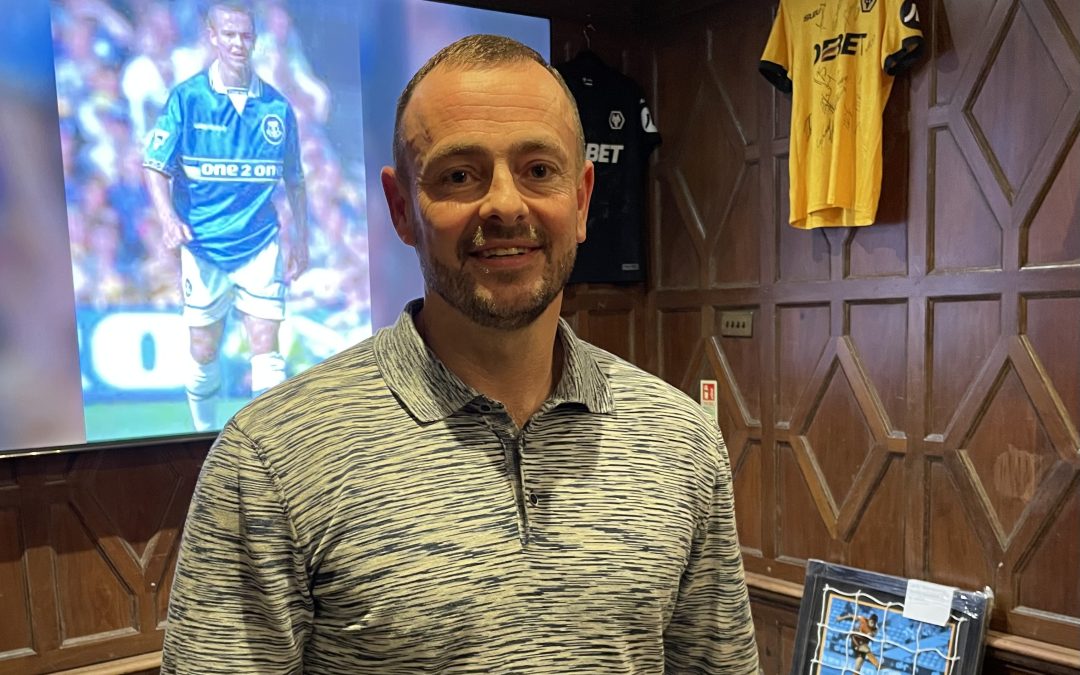
Speaking whilst the Mount’s Great Hall is empty prior to the event, for which he has donated a couple of matchworn shirts which help the night raise over £3,000 for a number of Guy’s chosen charities, Branch, now 47, admits it hasn’t been all that long that he has been completely comfortable about re-living his experiences.
When he does, it is with complete clarity and honesty about his fall from footballing grace to being incarcerated. ‘From Premiership to prison’, as the event was titled.
Branch is certainly not proud of his actions. Far from it. But he understands why it happened. And in many ways doesn’t look back with any regrets. He believes it has helped make him the person that he is today, a person who has rebuilt his life and has an approach of gratitude and giving back. Which is already having a hugely positive impact on those around him and further afield.
It is an incredible story, and one about which Branch should feel substantially proud. It could, already, have had a very different ending. But instead, still has so many more chapters to come.
But firstly, what of the football? What were the foundations that propelled Branch into the forefront of the Premiership scene as a teenager making waves alongside and against some of the biggest names in the sport?
Spurred on by his fiercely supportive Dad, a motivation he often found an unwanted pressure albeit they have since resolved any issues and are now ‘best mates’, Branch came through the Academy at his beloved Everton to get his teenage kicks at first team level.
His pace and skill and finishing ability also flourished on the international scene, representing England at various junior age groups all the way up to an Under-21 appearance, in the same team as Beckham, against Angola in 1996.
In total he made nearly 50 appearances as a young striker for Everton, many of them off the bench, with a potential which was clearly evident.
But already, the inner demons were circling, and, even if things may have looked positive above the surface, below he was very much swimming against the tide.
“I was very much a confidence player, and used to replay everything in my mind after a game,” Branch admits.
“I was my own worst critic.
“Sometimes, I would look at the clock and we’d have played 70 minutes and, if I’d had a decent game, I’d be wanting to come off because I feared doing something in the last 20 minutes that would spoil it.
“There was also all that pressure on me about being the next Robbie Fowler, which I couldn’t get away from.
“If I put the radio on, the telly, picked up the (Liverpool) Echo, went to the shop and spoke to people, there it was.
“Back then I was young and immature and didn’t have the skills or coping mechanisms to handle that pressure.
“And there just wasn’t the same level of support as there is now.
“We had a manager, couple of coaches and a physio, compared to now when they have massive numbers of backroom staff and people to help players with anything that they need.
“I don’t want this to sound like I am not taking responsibility because what happened is only my fault, but I was someone who needed help at the time to deal with the demands that I was facing.”
As it was, the disappointment of ultimately leaving Everton, and joining Wolves on loan then permanently, was tempered by a fresh start away from that pressure and stifling expectation.
Branch’s home debut, against a Manchester City side with whom he had also enjoyed a short loan spell, was pretty much perfect.
Friday night under the lights at Molineux and he grabbed a clinical brace in a 4-1 win.
Having hit the ground running, Branch very quickly settled in, living near Albrighton where he was able to relax away from the scrutiny faced on Merseyside.
He also fully integrated himself into the squad and dressing room, counting Kevin Muscat as his best mate along with Brentford boss Keith Andrews, who was his best man and godfather to one of his three children.
On the footballing side, he forged decent partnerships with Ade Akinbiyi and Adam Proudlock, who was at the Mount to catch up with his former team-mate, and thoroughly enjoyed playing for Colin Lee.
And when heading over to Australia for a couple of years after coming out of prison, he caught up with Darren Bazeley.
Branch’s 78 appearances during three-and-a-half years, from which he notched ten goals, are the most he made for any of his clubs, at a time when Wolves still battled in vain to try and reach the Premier League.
The arrival of Dave Jones, a fellow Evertonian who hails from the same part of the world, could have been the catalyst to push on to greater heights.
Sadly, it wasn’t to be.
“I’d started playing on the right and was doing well, and thought I’d get on with Dave, who said he was going to get me a new contract the one summer,” Branch explains.
“Then I’m away on holiday and I read in the papers that Wolves were going to sign Shaun Newton!
“I was wondering what was going on and then I came back and got injured, and that was pretty much that.
“I owe Dave an apology if I ever see him again, because I wasn’t the best at that time.
“I was acting like a child, it was all about me, but again, I just couldn’t really handle what was going on around me.”
If there was any sort of on-pitch analogy of the chaos that would later envelop Branch’s life – and clearly, it’s still not in the same stratosphere – then it arrived courtesy of a home game against Nottingham Forest in February 2000.
Akinbiyi and Forest defender Tony Vaughan had already seen red and Ludo Pollet and Bazeley had put Wolves two goals to the good when Lee Naylor went down injured and visiting keeper Dave Beasant kicked for touch to allow for a stoppage.
Branch however, seemingly unaware of Naylor’s plight in the Wolves left back position, retrieved the ball before it went out and ran in and beat Beasant with an excellent finish before the keeper then started chasing him around the Molineux touchline with a sense of angry comedy.
Guy plays the video clip at the Mount, to much amusement from the audience, as Branch, with a smile on his face, playfully puts his head in his hands!
“Play to the whistle, that’s what I was always told,” he laughs.
“As far as I was concerned, Dave Beasant had shanked it, and I picked it up and ran in and scored.
“I genuinely had no idea that Nayls was down injured at the time – but I found out pretty quickly that was the case!”
Branch was substituted not long afterwards as the game descended into even further turbulence but unfortunately, the real life turmoil was still to follow.
After loan spells with Reading and Hull he found permanent homes at Bradford and Chester, then in League Two, until finally, one morning, years of mental struggle came to a head.
“I can still remember it, one day I just phoned the Chairman and said I wasn’t coming in,” Branch recalls.
“I had fallen out of love with the game for a long time, I just wasn’t enjoying it, and just because you are good at something, it doesn’t mean that you enjoy it.”
Without the sort of support networks in place now, Branch struggled to adapt to life after football.
He readily admits he started drinking too much, and the lack of structure which is so important for a footballer left him ‘in a spiral’ from which it seemed there was no escape.
He also had ‘football bills to pay’, and again, by his own admission, an ego to maintain, which ultimately led him to a different circle of friends and acquaintances, and eventually, dealing drugs.
And yet, as mentioned earlier, hitting rock bottom ultimately proved the catalyst from which Branch has now built a new life and a new purpose. The comeback has been considerably stronger than the setback.
“What happened after I finished playing is all a bit of a blur, I really wasn’t thinking about a job or what to do next, and I was just about surviving day to day,” Branch admits.
“And that was the start of a spell when I started making some really bad choices.
“It really isn’t a case of ‘poor me’, and ideally, I wouldn’t have gone through what I did, but it really was the best thing that ever happened to me.
“I have a strong faith now, and believe that God took me out of a situation and going to prison was what was needed to happen.
“At first it was daunting, and a first night in prison isn’t nice, but what it did was give me that structure, which I had been missing.
“I knew when to eat, when to sleep, when I could go to the gym, I didn’t have to deal with anything else, I didn’t have to ‘do life’, and I felt safe.
“I even got my head down and was on the winning football team!
“What was absolutely massive for me was getting counselling in prison, because that was the first time I’d ever had that opportunity.
“That was the best decision I ever made, it changed everything, and it might sound dramatic but without that I’m not sure I’d still be here.”
Prison was certainly interesting for Branch in many respects.
He met a guard who he had played alongside in the Everton youth ranks, albeit at first he tried to hide from that fact, and also studied for a qualification in accountancy as he pushed to get his life back on track.
A decade on from his release, his impact across the community has been substantial.
To some extent, he is something of an awkward hero – he admits that it is only more recently he has become more comfortable in sharing his story – but there is unquestionably a power to that story which can positively impact people of all ages.
To their immense credit Everton kept in close touch with Branch throughout his sentence, and, after release, he worked with their renowned Community department before landing a role on the club side for Fan Services. Even there, he aims to forge a new pathway without relying on the name he made at the club on the football pitch.
“When I first started, I was chatting on the phone to a guy who needed help moving his season ticket to the new stadium,” says Branch.
“After I had helped him, he told me I’d been amazing and asked my name, so I just replied with ‘Michael’.
“He then replied, ‘Michael what?’ and I told him, and he went, ‘ah I wonder what happened to him!’
“I do try and keep it quiet a little bit but at the same time I am also proud of what I did at Everton and proud of playing for the team that I love.”
Away from the day job, Branch is also having a massive impact.
He champions the importance of exercise for positive mental and physical health, and during December, took on a fundraising challenge of running an extra 1km each day all the way to Christmas to raise funds for James’ Place, a suicide prevention charity offering free life-saving treatment to men.
He also set up the Social Striders free running group in Liverpool, which aims to improve mental health by a combination of morning runs and meaningful conversation.
That’s an approach which has served him well personally, and is now doing the same for hundreds of others.
“Just talking, it’s so important, especially for men who maybe don’t talk or who find it a struggle, and I am still like that sometimes,” Branch admits.
“But if you just talk, it lightens the load so much, and no one is ever going to think any worse of you for doing it.
“It saved me, no doubt about it, and I think because of everything I have been through, it has become a motivation for me to help others.
“I’d like to do more, but I have to be careful and not look too far ahead, just making sure I enjoy the moment.
“Even now, I’m a bit nervous about tonight, but then I make sure I take a step back and enjoy the moment, don’t rush it, enjoy telling my story and just take everything in.
“If you are looking back or looking forward, it’s so important to just take it all in for a minute, for a day, and enjoy it…enjoy life.
“Of course, I still have tough days, like we all do, but I’ve got a toolbag now of different tools I can use when I’m feeling it – I know how my head works now, but back then, I didn’t.”
As Branch admits, there are some who found themselves on similar journeys to his who have never recovered. But he is doing so.
Now able to call on a strong network of support from friends and family, he has a great relationship with his three children, two of whom joined him in completing the Liverpool half marathon on Sunday.
His partner Laura, who is with him at the Mount, is also a constant source of support and is currently trying to help him retrieve some of the England caps which he was given as a junior but passed on over the years.
Now he has more confidence in himself, and a purpose, so whereas previously he might have said he played for Wolves and for Everton before adding a ‘but’, and a negative, he is able to feel pride not just in the work he is delivering now, but also the heights he scaled as a footballer.
There is always more to do, more work to be done, more challenges to face.
But it’s been an incredible journey since looking out of the window of that prison van and seeing the lights of Goodison in the midst of the most difficult time of his life.
A journey of giving back and making a difference. One step at a time.