Mark Williams once found the net for Wolves against Craven Cottage, just months before the moment of his life changed the sporting landscape of a nation. After years of struggles through apartheid, South Africa were able to celebrate a triumph which brought the country together. As Paul Berry discovered.
*
It is 30 years since Mark Williams scored his only goal for Wolves, in a 5-1 away win against Fulham in the League Cup.
A nice goal too, exchanging passes with Mark Atkins before turning inside the defender and, with the calm patience of any top goalscorer, finishing confidently past Tony Lange.
A good moment, on a very good night. But let’s be honest. It pales into complete insignificance in the life and times of Mark Williams when you consider what happened just four months later, on February 3rd 1996.
That was the incredible afternoon, in front of a crowd of 80,000 at the FNB Stadium in Johannesburg, that Williams wrote himself into South African folklore.
In the final of the African Cup of Nations, on home soil, with legendary President Nelson Mandela in the crowd, Williams came off the bench to score twice in three minutes to see off Tunisia and send a country into total delirium.
Just four years after being reinstated by FIFA after years of suspension due to the decades of racial segregation of apartheid, ‘Bafana Bafana’ were top of the pile in African football. It was their first ever AFCON, and they haven’t won it again since.
Coming just six months after the Springboks had lifted the Rugby World Cup in the first tournament they were allowed to enter, also on home soil, South Africa felt as though they were on top of the sporting world.
Thanks in no small part to Williams’ heroics.
“We had not long been back in FIFA and I remember Clive Barker the coach telling me I was going to be part of the future of the national team,” he explains.
“I’d only been at Wolves for a few months and they were keen for me to stay with the club rather than go to AFCON, and actually offered me a bonus on top of my salary.
“It was a big decision for me, and it wasn’t easy, but when your country calls, it has to come first.
“And I think it proved to be the right decision!
“When you think about apartheid and what life had been like, we hadn’t been given equal opportunities, and life had been difficult.
“But when opportunity came to me in that tournament, and I had those chances in the final, I just made sure that I grabbed it.
“We followed on from the rugby team, the Rainbow Nation, players of all colours, who when they went on the pitch, were unstoppable.
“And to meet Nelson Mandela, well that was just incredible – what a President, he loved the game so much and knew about every single player.
“The ‘Madiba Magic’ as it was called, the impact of Nelson Mandela…that meant so much to us, and when he spoke it just lifted us and made us want to give everything.
“He used to tell us about how sport could change the lives of each and every person in the country, and that is certainly what happened in 1996.”
For it to be Williams who popped up with the crucial tournament-defining goals on that euphoric February day was particularly poignant.
When you talk about apartheid, discrimination, poverty, and the troubles endured by so many young South Africans of that era, he was very much a part of that troublesome situation.
Growing up with his mother and five siblings in a one-room house in Rondevlei in the Western Cape, time was spent with friends, often at a local scrapyard, until at the age of nine, social services decreed that Williams and his older brother needed to move, to live with their father and grandfather in the suburb of Claremont.
A predominantly white area, at first Williams initially concentrated on sport, enjoying rugby and athletics and then, on his 11th birthday, being given a football by his father.
He loved it, but at the same time was wrestling with other issues. Riots took place in the late 1980s, and apartheid meant a young Williams had to move again, to Hanover Park with his grandfather, and stop playing for the Claremont football team.
Gangs were prevalent, and even though Williams didn’t want to get involved, often there was no escape. Sometimes it would take an hour to walk the normally two-minute short distance to his flats to avoid trouble. On one occasion, he recalls friends being stabbed and killed during one especially horrific episode. Somehow, he managed to flee. But violence had become almost normalised.
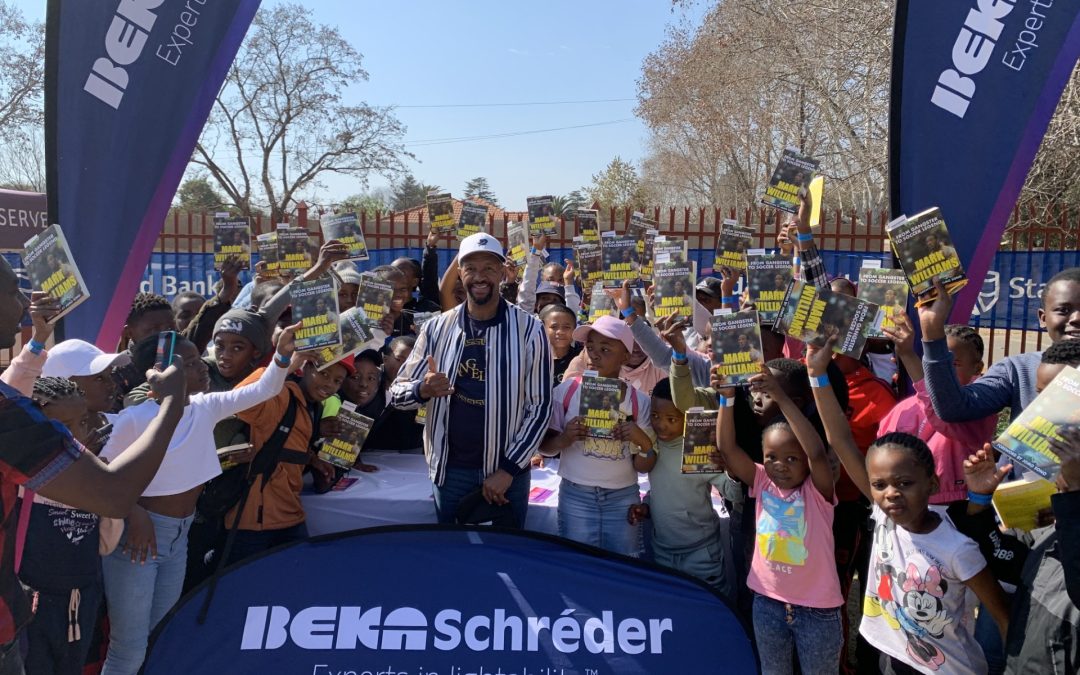
‘From gangster to soccer legend’ is the title of Williams’ autobiography. Included are details which he is not particularly proud of, but which were also an inescapable reality.
“It’s in the book but it’s not something I always want to talk about,” he admits.
“What I did learn from it, and what I say now, is that it isn’t where you come from that matters, it is where you are going.
“The fight and belief I had in my football career probably came from those early years back in Cape Town, and by the grace of God I came through it and will always have that belief.”
Williams took it upon himself to escape from the gangs. He fled to Parkwood, to be reunited with his mother, and a whole new start. A return to education didn’t work because he was so far behind, but he found work, and a Sunday League team, and soon football took over.
Spotted by a scout, he joined Hellenic FC, and then progressed to Jomo Cosmos and Sundowns, before heading to Europe, with RWD Molenbeek in Belgium.
And then, thanks to a Wolves fan, came the prospect of heading over to Molineux.
“This was strange,” Williams acknowledges.
“I went to an English pub in Brussels and one of the guys in there said I should join his team, and that team was Wolves.
“He said he could organise a trial, and was true to his word, so I came over and tried out at Wolves for Graham Taylor.
“He said he was happy with me and offered me a three year contract, and after that I bought a season ticket for the fan who had recommended me!
“Signing for Wolves was a massive moment in my career, and I was ready to give it my all.”
Wolves at the time were heading into their first full season under Taylor, having missed out on promotion via the play-offs via a controversial defeat against Bolton.
“Graham Taylor, may he rest in peace, he was the one who gave me the opportunity,” Williams explains.
“When I came and did the trial and medical tests, he said he liked what he saw and offered me a three-year contract.”
A couple of months after his arrival however, Williams was working under a new manager, with Taylor replaced by Mark McGhee.
“Not only the manager, but so many of us were called Mark that when he called that name, we didn’t know who he was talking to,” Williams says with a laugh.
He remembers John De Wolf as the strong and inspirational captain, the pace of Tony Daley, the rivalries with Birmingham, West Bromwich Albion and Aston Villa who Wolves played in the FA Cup just after he departed for AFCON. And, of course, Steve Bull.
“Steve Bull, what a legend,” says Williams.
“He was the main man for what he did for so many years and I was brought in to add a bit of extra spice from Africa!
“When I came, I was playing on the one wing and Tony Daley on the other, and both of us had a lot of pace.
“All we wanted to do was to create chances to give Steve the service to score the goals.”
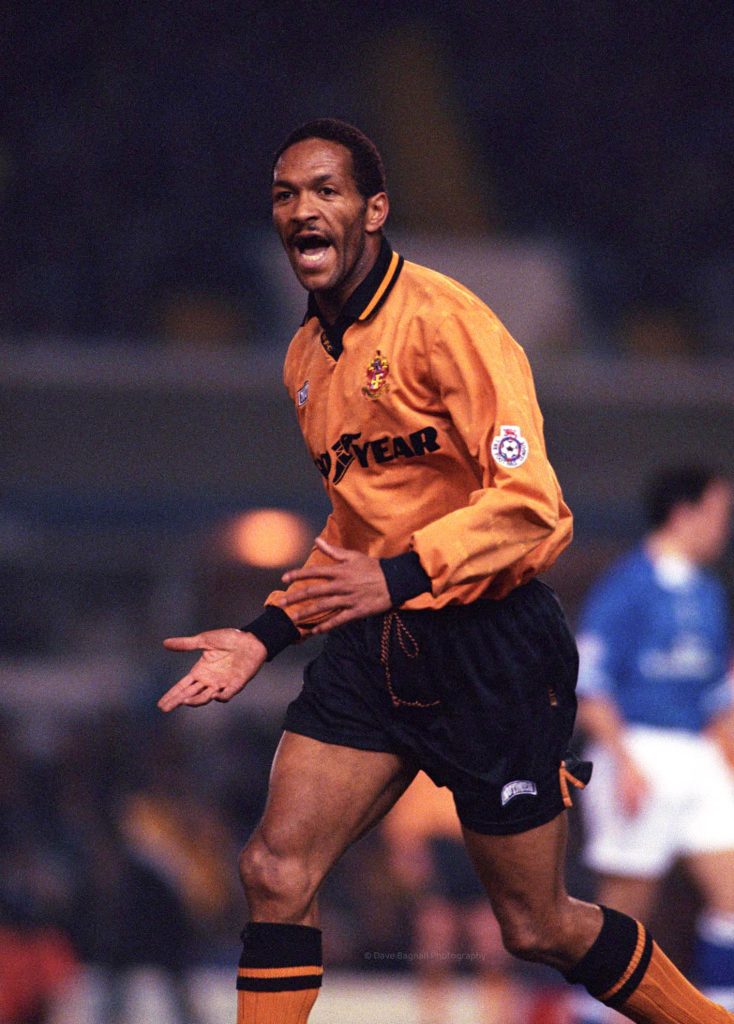
Playing out wide offered Williams fewer chances to get amongst the goals himself – another one he may have claimed at Ipswich was credited to Mark Atkins – but his brace in that memorable AFCON final made it four in the tournament, and saw him return to Molineux with plenty of confidence.
Unfortunately, it wasn’t to be, with limited openings in the first team under McGhee, before injury ended his season, and ultimately his Wolves career, against Crystal Palace.
“I remember in my first game back that I was presented with a nice crystal on the pitch by the chairman for my achievements in the tournament,” Williams recalls.
“Mark McGhee told me I needed to fight for my place, and that was absolutely fine, but he had made Steve Bull captain and obviously that made it a struggle to play up front.
“Steve was coming towards the end of his career, and I’d have loved to have been there to try and follow on, but I didn’t want to stay and sit on the bench, and that was what was happening.
“We decided it would be best for me to move on at the end of that season.
“I definitely have no regrets though, it was the correct time in my life to move to Wolves – the way they love their football at Molineux – and I would have loved to have made more memories.
“I just wanted to try and showcase my talents and in the end, I was sad to leave, but that is sometimes how football works.”
Williams’ footballing tour of the globe continued after Wolves, leaving Europe to head to Brazil to play for Corinthians, where he made his debut in front of a crowd of 135,000 at the Maracana.
He later turned out for several clubs in China, as well as playing in Saudi Arabia, and, even after retiring from the conventional game, played beach soccer for South Africa.
Now though, at 59, he has a new focus. A focus on giving back. Just over a year ago, he launched the Mark Williams Foundation, aiming to leave a legacy of empowerment and using sport, mentorship and education to support young people and shape the next generation of leaders.
With lived experience of so many hardships, including poverty and gang violence, and having taken advantage of the opportunities opened up by playing football, it feels a perfect fit.
“Despite everything that happened to me growing up, I was able to go and have a career and some success, thank god, and all the hard work paid off,” Williams explains.
“And that’s what I say to the kids now, if you put in the hard work, if you keep going, at some point it will pay off.
“I love talking about my life and my experiences, trying to lift people, because when you give back – when you try and give an opportunity to someone who hasn’t had that opportunity before – no amount of money can ever replace that feeling.
“I always want to give my time, to help people believe, and through the Mark Williams Foundation, we are trying to change lives for the better.”
It’s quite the story, and one which is still going strong.
In a couple of weeks’ time, Williams, now living back in Cape Town where it all began for him, is being inducted into the South African Hall of Fame alongside his 1996 team-mates Mark Fish, Mark Williams, Doctor Khumalo, and Aaron Mokoena.
In the longer term he would love to take the power of his message and his Foundation onto the road, to film a documentary where he visits all his previous clubs to talk about his football, and his life.
He wasn’t the first South African to play for Wolves, but he remains the most recent.
And would love nothing more than others following in his footsteps by gracing Molineux in the future.
“When I represented my country, I always felt I was doing it not just for myself but for all those other Mark Williams’s who might have faced some of the hardships that I have,” he admits.
“That’s why I want to try and tell my story as much as I can, and to me, Molineux will still always be a very special place.
“Who knows? Maybe one day there will be more South African players heading over to Wolves, and the next Mark Williams can be a star at Molineux.
“Wouldn’t that be something?”