Former Wolves’ utility man Greg Halford also played for the most recent opponents, Brighton, and the next, Sunderland. He recently called time on a career which had its up and downs, but his impact on football, on and off the pitch, could still be considerable. He’s also about to head into the boxing ring. Paul Berry finds out more.
*
By his own admission, Greg Halford has always been something of a straight talker.
“I don’t really sugar coat anything, and sometimes that has got me into trouble,” he acknowledges.
“But I have never meant any harm or disrespect by it, it was just me showing how I felt or what I thought.”
It might have landed him in bother with different managers during his career. And indeed with fans, including those of Wolves, on social media.
It does mean however, that he has always remained true to himself. With a strength of character which is now seeing him heading into the boxing ring to take on fellow former professional Marvin Elliott on a night, organised by former Wolves goalkeeper Graham Stack, which will raise hundreds of thousands of pounds for charity.
And all this alongside building a new coaching career with the academy at Middlesbrough, and developing a couple of new businesses. Busy times.
The Halford story is one of many different nuances.
His time at Wolves, despite some promising moments, didn’t go according to plan. The same probably applies to other Premier League spells with Sunderland and Reading.
But overall, his career offered plenty of success.
A total of 653 appearances – in various positions – and 76 goals, included two promotions, an appearance at a play-off final, recognition with England Under-20s, and a place in the PFA Team of the Year.
Halford only retired, at the start of this season, at the age of 40, having represented over 20 different clubs, a statistic which in itself, has some influence on his journey.
Because part of the reason behind so many clubs, and a struggle to settle quickly in new surroundings, is that, eight years ago, after his son was diagnosed with autism, Halford also underwent an assessment and discovered that he, too, is on the spectrum.
Whilst he would never use that as any sort of excuse for some of the more challenging periods of his career, it will undoubtedly have had some impact.
It is also why Halford is keen to speak to the FA and PFA about offering support to younger players who may find themselves wrestling with daily life at a football club whilst also being on the spectrum, just as he did.
“When I look back on my career, I think I missed out on what I would have wanted to achieve at the three Premier League clubs,” he admits.
“I played for three different teams in the league and didn’t break 50 appearances in total.
“That’s a big regret, but looking back on the circumstances, I can definitely understand it.
“They were my first three moves as a player after starting out at Colchester, so right at the beginning of my career, which was all a challenge in terms of changing scenery.
“Moving away from family, meeting new people, linking up with new team-mates, working with new coaching staff…I struggled with all of that during my early moves.
“Now knowing about my autism diagnosis which came later, I think that was certainly a contributing factor.
“I would never want to use it as an excuse and I should have done a lot better than I did, but I am sure it played a part in why I didn’t settle and play my best football.
“My best spells at that time were loans at Sheffield United and Portsmouth, and that was only maybe after I had been there for six months or so, whereas in the Premier League the managers are under so much pressure to get results that if you don’t do it on the pitch, you are out, no matter what the circumstances.”
There were, though, as mentioned, many highlights during Halford’s career.
Those promotions, at the start of his career with Colchester to the Championship, and later on to the Premier League with Cardiff, are obviously right up there.
The England recognition, for the Under-20s in the Toulon tournament in a team including the likes of James Milner, Tom Huddlestone and Peter Whittingham, during which he scored against Korea and converted a penalty in a shootout defeat against France in the semi-finals.
Even in the latter stages, when turning out for Hashtag United, the team formed less than a decade ago by YouTuber Spencer Carmichael-Brown, Halford was a key player in securing promotion from the Isthmian League North division. There has been much to celebrate.
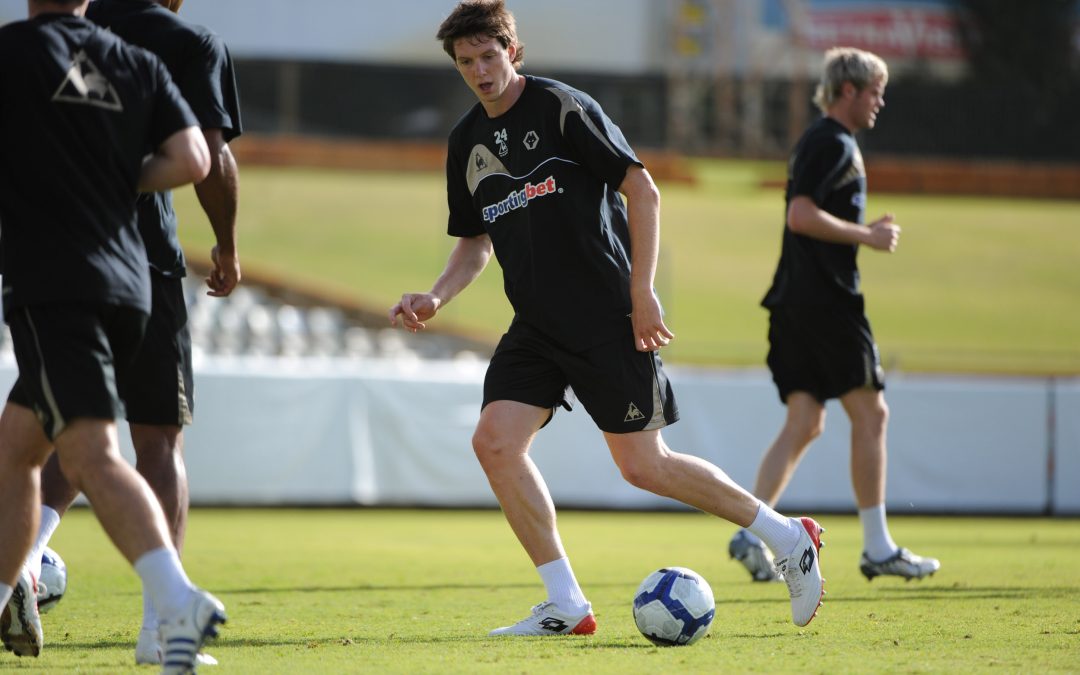
Back to Wolves, then. Halford arrived as one of a string of new faces in the summer of 2009 in preparation for the Premier League after promotion from the Championship.
He was signed and then immediately found himself on the plane for the 24-hour flight to the pre-season tour of Australia, another challenge in terms of bonding with his new team-mates and making that all-important first impression.
He started the season in the starting line-up, impressing in the opening day defeat against West Ham and keeping his place for the club’s first ever away win in the Premier League at Wigan.
Very much in and around it over the first half of the season, appearances were fewer post-Christmas, and Halford only made a further four in the following campaign before a loan move to Portsmouth, which eventually became permanent.
But even if he had been out of favour towards the end of that first season, his return and approach during the subsequent pre-season drew praise from boss Mick McCarthy, and seemed to have temporarily revived his Wolves career.
“I came back really strongly in that second pre-season, and remember scoring with a nice free kick in a friendly at Hearts,” Halford recalls.
“Everyone was building up a bit of hype around my performances, but then I did an interview where I talked about the fact I’d gone sober, which was taken out of context in suggesting I’d previously had a drinking problem.
“It was nothing like that – I mean most footballers will have a drink or two after a game over a weekend – but I was just saying I had made a conscious effort to do everything I could that was positive to help me get back into the team.
“I wasn’t going near alcohol but it was more than that, I was eating clean, doing extras in the gym, and had just made football my only priority.
“It all seemed to be perceived a bit negatively and, in the end, it didn’t work out at Wolves, but it had started well in that first season, and I don’t carry any bad feelings.
“The straight talking got me in trouble a few times, and I clashed with Mick, just like I did with Keeno (Roy Keane) when I was at Sunderland.
“With Mick it was never nasty, I have the utmost respect for him and what he has achieved.
“I didn’t agree with all his coaching methods, but every manager has their own way, and I always completely respected that.
“I don’t have anything bad to say about any of my managers to be honest – well maybe one or two – but Mick is definitely not one of those.”…
- Express & Star subscribers can read the full article here – https://www.expressandstar.com/sport/2025/10/09/it-got-me-into-trouble-greg-halford-on-wolves-regrets-helping-others-in-football-with-autism-and-his-new-boxing-challenge/